What Al-Khidr Taught Me

I never intended to engage in any kind of Islamic work.
Before Sufiquest, the furthest my thoughts about life would go were to simply be a good Muslim, finish college, get married, and have children.
I wanted a simple life—one without pain or disruption.
What I didn’t realize was that I was trying to follow a template I had been conditioned to accept, rather than truly understanding what was being asked of me by Allah.
For a long time, I believed I had nothing to offer.
“Who am I to speak about Islam when I feel ignorant and lost?”
I had grown up with a sense of not being enough, and without realizing it, I surrounded myself with people and environments that reinforced that belief.
And yet, beneath all of that, there was something else.
A quiet awareness that Allah had guided me to Islam—not just to follow it outwardly, but to discover something deeper through it.
After a period of intense grief, something within me changed.
That year left me empty in a way that was both painful and necessary.
It stripped away the expectations, attachments, and identities I had built around myself.
And in that emptiness, something became possible.
One afternoon in April 2019, while sitting alone in my living room, I heard a clear instruction:
Open an Instagram account.
Call it Sufiquest.
Share what you’re doing to heal.
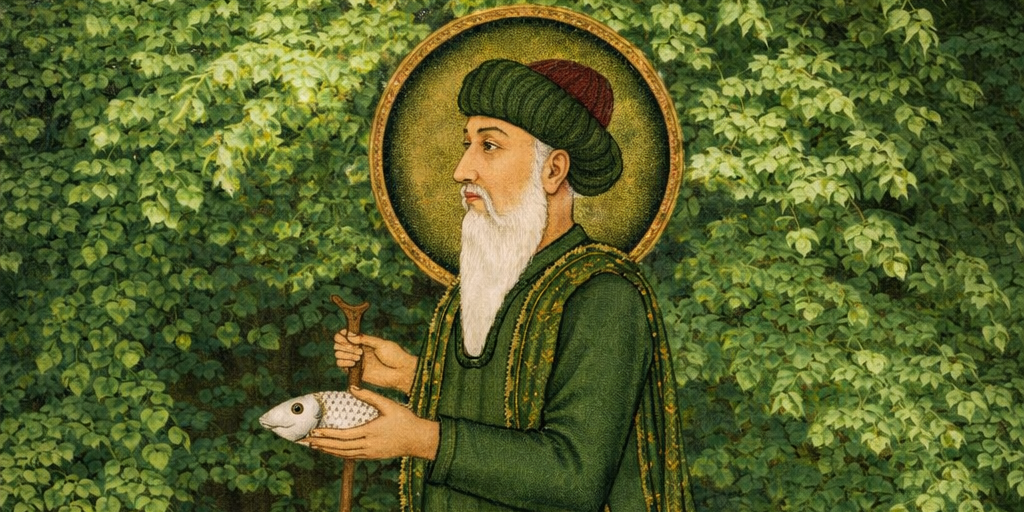
Al-Khidr will show you the way.
At the time, I did not fully understand what that meant.
But I followed it.
And over time, I began to see.
In the Quran, the story of Prophet Musa (as) and the servant of Allah—known in our tradition as Al-Khidr—reveals something essential about the nature of guidance.
Prophet Musa (as), despite his knowledge and status, could not understand the actions of Al-Khidr.
What appeared unjust…
What appeared harmful…
What appeared confusing…
Was, in reality, rooted in a wisdom beyond what could be immediately seen.
I found myself in that same place.
There were moments in my life that felt unclear, even painful—moments I could not make sense of.
And yet, slowly, I began to understand:
Not everything that feels like loss is loss.
Not everything that feels like disruption is misguidance.
And not everything that appears difficult is without purpose.
What Al-Khidr taught me was not through explanation.
It was through experience.
He taught me that:
- guidance does not always come in ways we expect
- clarity is not always immediate
- and understanding often comes after patience
He taught me that being emptied of the ego is not a loss, but a preparation.
Because when the noise of our own desires quiets, something else can be heard more clearly.
That moment—the instruction to begin—did not come from a place of certainty about what I was doing.
It came from a place of surrender. I did not know where it would lead.
I only knew I had to follow it.
Sufiquest began from that place. Not as a plan, but as a response.
Not as something I created, but as something I was guided into.
Over time, I shared what I was learning—often through the words of the awliya (Friends of Allah), whose teachings accompanied me through my own process of rebuilding.
Their words carried a depth that I could not yet articulate, but could recognize.
And slowly, I began to understand something else:
That guidance is not limited.
That Allah speaks to each of us in ways we are able to receive.
And that the path is not always clear—but it is always unfolding.
My journey is still unfolding, just as yours is.
We are all travelers in this life—each at a different stage, each being guided in ways we may not fully understand yet.
And perhaps this is what Al-Khidr teaches us:
To trust what we do not yet understand.
*Although Al-Khidr is not mentioned by name in the Quran, Islamic tradition widely identifies him as the “servant of Allah” described in Surah Al-Kahf (18:60–82), in the story of his journey with Prophet Musa (as).


